
 x.com
 Facebook
 LinkedIn
 Pinterest
 Reddit

A therapy mask is often marketed as anti-aging, but a therapy mask can also help acne—within limits. A therapy mask is an adjunct anti-inflammatory tool, not a primary antibacterial treatment. A therapy mask can cool inflammatory breakouts, but a therapy mask cannot replace antibacterial care. Placed correctly, a therapy mask is not hype; placed wrongly, a therapy mask disappoints. The real value of a therapy mask is that it does not pretend to do everything.
The Therapy Mask Role Is “Firefighting,” Not “Sterilizing”
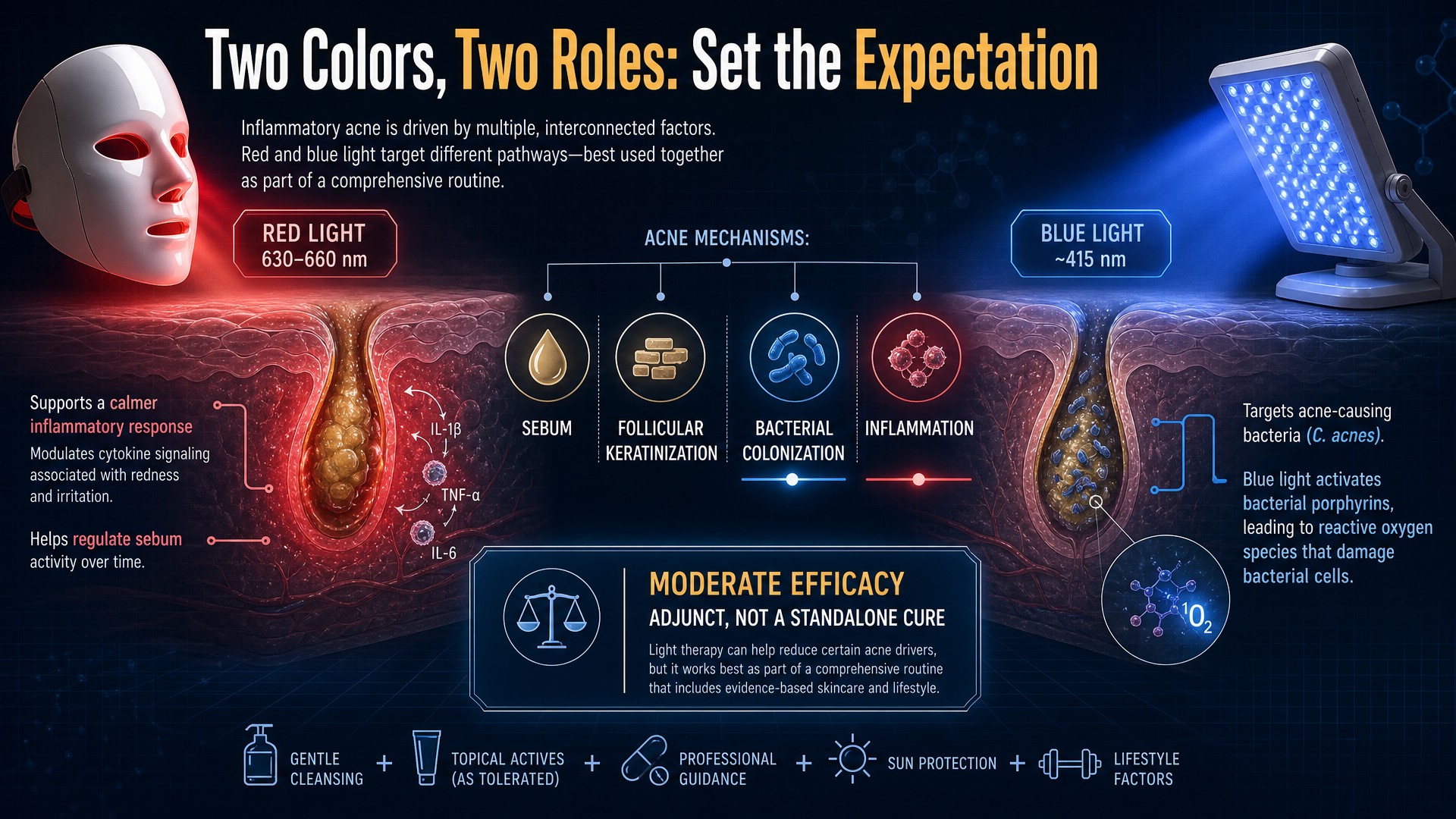
Acne involves sebum, abnormal follicular keratinization, bacterial colonization, and inflammation. A therapy mask with red light around 630–660 nm targets the inflammatory side: a therapy mask can modulate cytokines and reduce sebum activity. A therapy mask can ease redness and speed resolution of inflammatory papules. But a therapy mask is far weaker than blue light at killing C. acnes. Blue light around 415 nm activates bacterial porphyrins; a therapy mask alone does not. A 2026 review covering professional devices and consumer LED found evidence supports blue and red light for inflammatory acne with moderate efficacy. A therapy mask therefore has a real but moderate role. A therapy mask should not be sold as a standalone cure. A therapy mask works best when its role is clear.
Combined Blue and Red Light Beats a Red-Only Therapy Mask
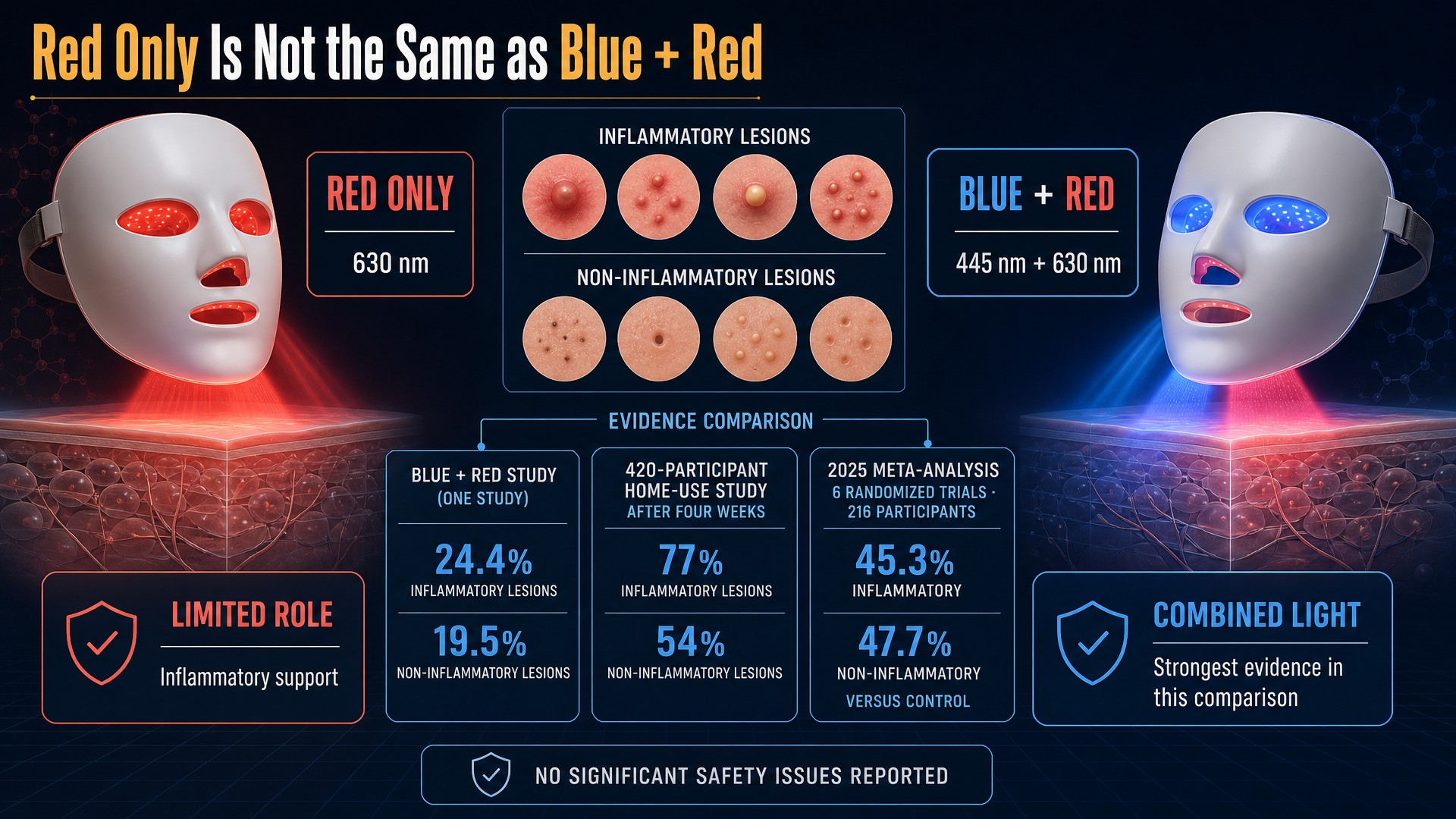
A red-only therapy mask is limited; combined blue and red light has stronger evidence. In one study, 445 nm blue plus 630 nm red improved inflammatory lesions by 24.4% and non-inflammatory lesions by 19.5%. Home data matter for a therapy mask: a study of 420 participants found daily home blue-red therapy mask use reduced inflammatory lesions by 77% and non-inflammatory lesions by 54% after four weeks. A 2025 JAMA Dermatology meta-analysis of six randomized trials with 216 participants found home LED devices—blue, red, or combined—reduced inflammatory lesions by 45.3% and non-inflammatory lesions by 47.7% versus control, with no significant safety issues. Researchers noted combined blue and red was most effective. So a therapy mask is useful for acne, but a red-only therapy mask is not equivalent to a combined therapy mask. A therapy mask works best when blue light is included.
Dose and Design Limit What a Home Therapy Mask Can Deliver
Those data come from controlled studies; commercial products may not replicate them. The same review noted consumer LED devices, including a home therapy mask, usually have lower irradiance and energy density and lack independent efficacy validation. A survey of 25 US devices found none supported by randomized trial data. A therapy mask therefore delivers “moderate” efficacy only if wavelength is accurate (near 630–660 nm), dose is sufficient, and use is consistent for weeks. A 2026 Dermatology Times commentary stressed that home red light improvement in photoaging is statistically significant but mild, depending on daily exposure and adequate output from a therapy mask. Acne care is similar: a therapy mask is not a one-session anti-inflammatory magic; a therapy mask must be part of a system including cleansing, antibacterial care, and medical treatment when needed. A therapy mask cannot replace that system. A therapy mask can only support it.
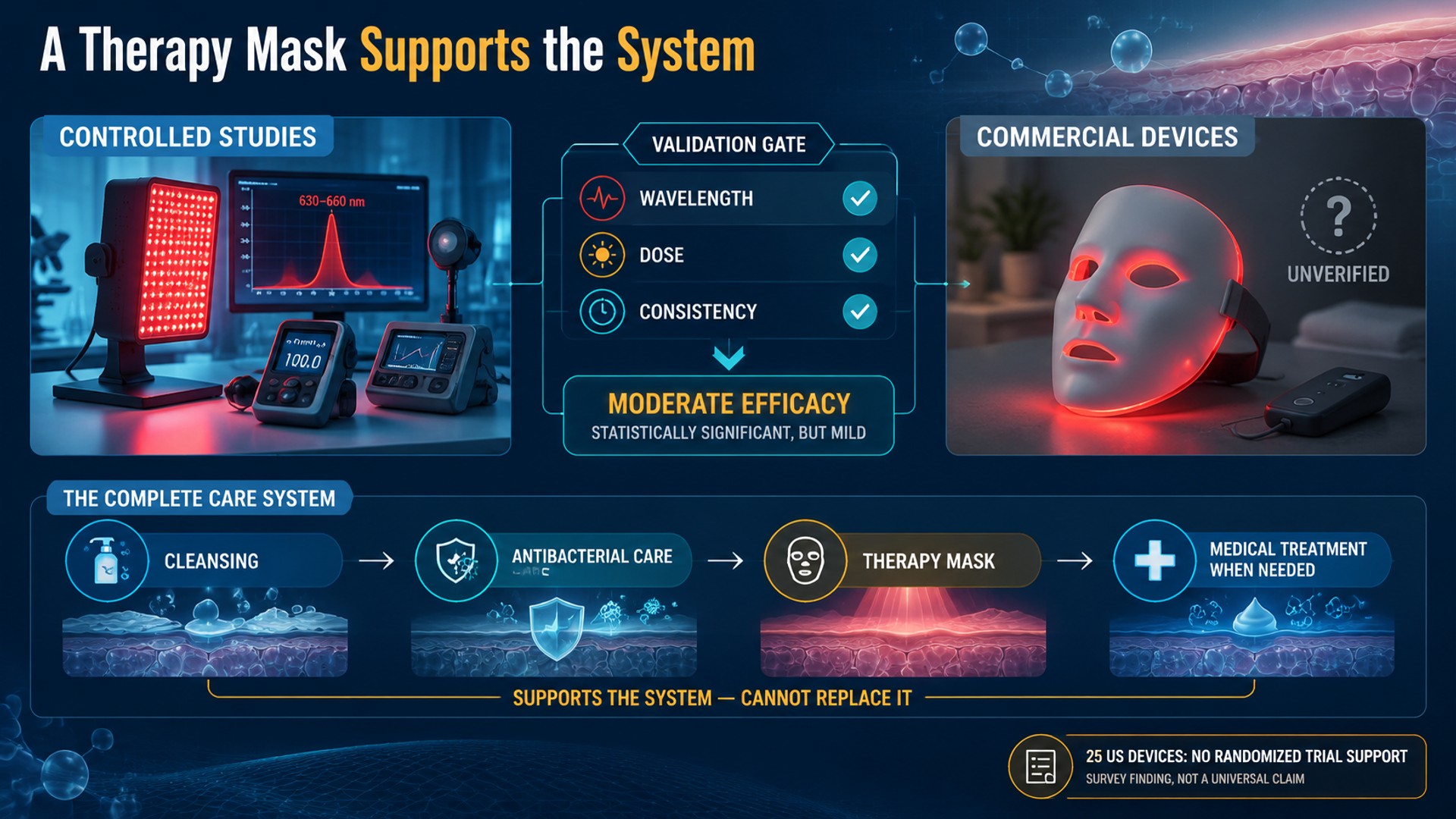
So a therapy mask is not “only for anti-aging.” A therapy mask does have an anti-inflammatory role in acne, but that role is adjunctive. A red-only therapy mask is weaker than combined blue-red light, and a home therapy mask is limited by dose and design. Used as a “cooling tool” for inflammatory acne alongside blue light or standard acne care, a therapy mask deserves the word “useful.” Used as a shortcut replacing antibacterial treatment or dermatologist prescriptions, a therapy mask cannot carry that expectation. The true value of a therapy mask in acne is exactly that it does not pretend to do everything.